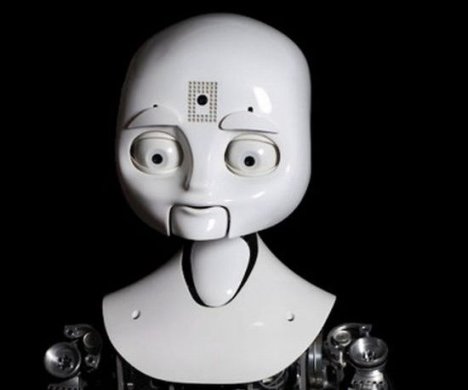
Many artificial intelligence experts argue that by 2040, machines will match human intelligence. Hans Moravec, one of the founders of the robotics department of Carnegie Mellon University believes that robots may even match human consciousness. Our civilization is growing more dependent on technology and machines with the amount of memory a small chip can hold multiplying every minute.The use of robots around the home to perform menial tasks such as mowing the lawn increased sevenfold by 2007 according to the International Federation of Robotics. There are currently over 21,000 "service robots" in use that perform tasks such as milking cows and operating theatres. The study states that by 2010, service robots will be able to carry out surgery, fight fires and assist handicapped people. As Isaac Asimov predicted, scientists are up against a paradox, “The more sophisticated an organism becomes, the more difficult it is to legislate rules to govern its behavior”. In order to be extremely useful, robots must be able to make their own decisions but once you give them this ability is when you give them the power to disobey.
Monday, November 10, 2008
No Thank You, Mr. Roboto
Many artificial intelligence experts argue that by 2040, machines will match human intelligence. Hans Moravec, one of the founders of the robotics department of Carnegie Mellon University believes that robots may even match human consciousness. Our civilization is growing more dependent on technology and machines with the amount of memory a small chip can hold multiplying every minute.The use of robots around the home to perform menial tasks such as mowing the lawn increased sevenfold by 2007 according to the International Federation of Robotics. There are currently over 21,000 "service robots" in use that perform tasks such as milking cows and operating theatres. The study states that by 2010, service robots will be able to carry out surgery, fight fires and assist handicapped people. As Isaac Asimov predicted, scientists are up against a paradox, “The more sophisticated an organism becomes, the more difficult it is to legislate rules to govern its behavior”. In order to be extremely useful, robots must be able to make their own decisions but once you give them this ability is when you give them the power to disobey.
Sunday, November 9, 2008
Black Hole Sun...Please Don't Come
The validity of this end to our times is credited to Stephen Hawking and Roger Penrose. A black hole is a region of space that has so much mass concentrated in it that nothing can escape its gravitational pull, not even light. If someone were to fall into a black hole they would be shredded to pieces, or as Neil deGrasse Tyson, director of the Hayden Planetarium at the American Museum of Natural History wrote, "the most spectacular way to die in space". The most frightening fact is that the galaxy is full of collapsing stars waiting to turn into black holes, estimated close to 10 million. Although black holes are currently orbiting other astronomical masses, they are nearly impossible to see. It would not take very much space for a black hole to come close to earth and wreak havoc. If this day of doom did arise, it would be noticeable. Our climate would change drastically and our planetary alignments would be in a complete disarray.
Subscribe to:
Comments (Atom)