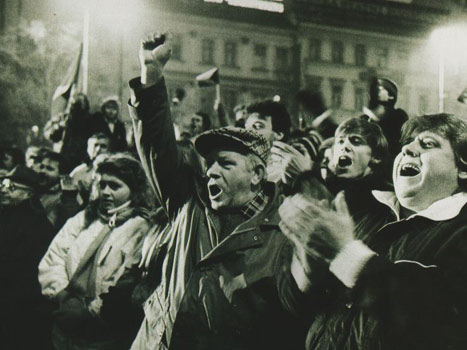
It is human nature to disagree. As long as there are people, there will always be political and cultural revolutions. With the growing stress of political, religious and ideological tensions, it is inevitable that the next revolution is upon us...but on what scale? The next cultural revolution could mingle with the spread of technology and if so, turn into a cataclysmic event. Most recently China went through a decade of chaos and political disarray between 1966 and 1976 over the struggle between socialism and capitalism. Mao Zedong the leader of the Communist Party of China began to influence the thoughts and action of China's Youth, creating Red Guard groups which filtered into the military and Communist Party. Mao urged the abolishment of "Old Customs, Old Culture, Old Habits and Old Ideas". The counterculture revolution in the US in the 1960's was a reaction to the austere political control in America, US intervention in Vietnam and an avalanche of movements concerning women's rights, race tensions and traditional ideals, coupled with the spread of psychedelic drugs. All it takes to start a revolution is an awareness of social repression and the power to collectively attack what needs change. The spread of technology and ideas through social network tools like Twitter and Facebook make having a revolution more organized and likely to occur. Radical enthusiasm and technololgy could start a revolution that could spread globally and ignite worldwide anarchy...if only.
Wednesday, November 4, 2009
Every Generation Needs a New Revolution
It is human nature to disagree. As long as there are people, there will always be political and cultural revolutions. With the growing stress of political, religious and ideological tensions, it is inevitable that the next revolution is upon us...but on what scale? The next cultural revolution could mingle with the spread of technology and if so, turn into a cataclysmic event. Most recently China went through a decade of chaos and political disarray between 1966 and 1976 over the struggle between socialism and capitalism. Mao Zedong the leader of the Communist Party of China began to influence the thoughts and action of China's Youth, creating Red Guard groups which filtered into the military and Communist Party. Mao urged the abolishment of "Old Customs, Old Culture, Old Habits and Old Ideas". The counterculture revolution in the US in the 1960's was a reaction to the austere political control in America, US intervention in Vietnam and an avalanche of movements concerning women's rights, race tensions and traditional ideals, coupled with the spread of psychedelic drugs. All it takes to start a revolution is an awareness of social repression and the power to collectively attack what needs change. The spread of technology and ideas through social network tools like Twitter and Facebook make having a revolution more organized and likely to occur. Radical enthusiasm and technololgy could start a revolution that could spread globally and ignite worldwide anarchy...if only.
Monday, October 26, 2009
Game Over
Are we the ancestors of an advanced race that has created a computer simulated world? Centuries of philosophers have mulled over the certainty of our external world. Our civilization lacks a concrete theory on our existence and although there is scientific evidence to validate our physical world, this could all be the product of powerful technology. Through science fiction, technologists and futurologists, we are recognizing the probability of a world where computers have more power. Nicholas Bostrom, Professor of Philosophy at Oxford University created the Simulation Argument which employs mathematics and probability theory. He argues there is a significant probability if the simulation hypothesis is true, "you exist in a virtual reality simulated in a computer built by some advanced civilisation. Your brain, too, is merely a part of that simulation". Computer technologists estimate the processing power of a computer to this capability could happen by mid-century. Instead of pondering over a Creator ending the world in divine intervention, maybe we should consider the chance of it ending by someone getting bored of a game.
Friday, October 23, 2009
Life is But a Dream
What am I? Who am I? What is our purpose? Every person finds themselves asking these questions at some point. We are told to believe the past with no answers for the future and are created with no direction, just free will. Most people go about their lives in routine, mindless of why they do the things they do. Others choose to desperately search for answers following religion, people, theories...anything that gives them a sense of security that we are in fact, real. But how real is our reality? When we are dreaming, does that not subconciously feel like reality? Chuang Tsu, an ancient Chinese Taoist, awakening from a dream in which he was a butterfly, wondered whether he was a butterfly dreaming of being a man. Dreams can often be so vivid and feel so real that they stir up deep emotion. What if our conscious reality was but a dream? Look around at the natural beauty of the world and how complex and intricately woven our environment and each individual organism is. It is difficult to grasp and our level of human intelligence can't even comprehend most ways of our universe. In a dream reality, everything seems real. Perhaps it is all just a dream and the end is when we wake up.
Wednesday, October 21, 2009
Money, You've Got Lots of Friends
Recently The New York Times headlines read, “U.S. Deficit Rises to $1.4 Trillion; Biggest Since ’45", and “Bailout Helps Revive Banks, And Bonuses.” Strife over the collapse of the world economic system poses a major threat for mankind. Ever since the Wall Street fiasco, the world has felt the aftershocks of its collapse and learned how sensitive the global economic system is to this conglomerate of complex banking systems. This contributes to the growing disparity that exists between classes and could grow so deep that it would be nearly impossible to reverse. From 2002-2007, two-thirds of the income gains went to the top 1% of Americans while tens of millions are unemployed or struggling to pay debt and make ends meet. America has one of the highest levels of income inequality. This inequality rose during the 80's and 90's across all countries and continues to grow at a startling pace. One of the calls of the four horsemen of the apocalypse predicts a time of worldwide famine, mass starvation and death for millions and at the same time, great wealth for others. Economic disintegration could lead to a worldwide economic meltdown which in turn could bring war, mass destruction and some really poor and pissed off people.
Tuesday, October 20, 2009
Gas Mask Fever
Technology and medical innovation have created a false security that may result in a global epidemic that would be out of our reach to control. Something as tiny yet complex as a germ could bring about an infectious disease that could sweep across from continent to continent. A pandemic of the Black Plague killed 40 million people in Europe in the 14th century and outbreaks in China, Brazil, India and Peru most recently have stirred up concern from epidemiologists. A rising population and increase in international travel bring us steps closer to disaster. We continue to build resistance to antibiotics and come closer to animal pathogens through our agricultural development. The worst case scenario would be an infectious disease that would spread so fast and have a makeup so strong that there would be no cure in time! We continue to challenge our delicate ecological balance and play with the butterfly effect. Even diseases like the swine flu could change strains and become a superflu that will wipe us all away to the high heavens.
Monday, November 10, 2008
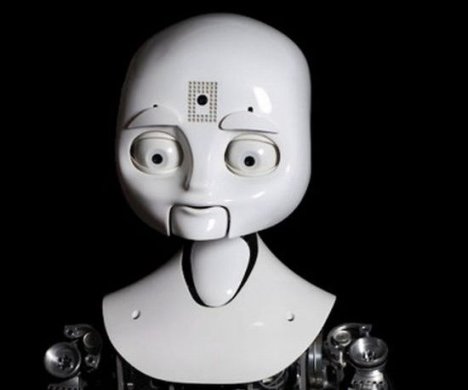
No Thank You, Mr. Roboto
Many artificial intelligence experts argue that by 2040, machines will match human intelligence. Hans Moravec, one of the founders of the robotics department of Carnegie Mellon University believes that robots may even match human consciousness. Our civilization is growing more dependent on technology and machines with the amount of memory a small chip can hold multiplying every minute.The use of robots around the home to perform menial tasks such as mowing the lawn increased sevenfold by 2007 according to the International Federation of Robotics. There are currently over 21,000 "service robots" in use that perform tasks such as milking cows and operating theatres. The study states that by 2010, service robots will be able to carry out surgery, fight fires and assist handicapped people. As Isaac Asimov predicted, scientists are up against a paradox, “The more sophisticated an organism becomes, the more difficult it is to legislate rules to govern its behavior”. In order to be extremely useful, robots must be able to make their own decisions but once you give them this ability is when you give them the power to disobey.
Sunday, November 9, 2008
Black Hole Sun...Please Don't Come
The validity of this end to our times is credited to Stephen Hawking and Roger Penrose. A black hole is a region of space that has so much mass concentrated in it that nothing can escape its gravitational pull, not even light. If someone were to fall into a black hole they would be shredded to pieces, or as Neil deGrasse Tyson, director of the Hayden Planetarium at the American Museum of Natural History wrote, "the most spectacular way to die in space". The most frightening fact is that the galaxy is full of collapsing stars waiting to turn into black holes, estimated close to 10 million. Although black holes are currently orbiting other astronomical masses, they are nearly impossible to see. It would not take very much space for a black hole to come close to earth and wreak havoc. If this day of doom did arise, it would be noticeable. Our climate would change drastically and our planetary alignments would be in a complete disarray.
Subscribe to:
Comments (Atom)